
Short answer
Repeated pressure loss means water is leaving your sealed heating system. The usual suspects are a leak somewhere in the pipework or radiators, water discharging through the pressure relief valve, or a fault in the expansion vessel or filling components. Topping up buys time, but if you are refilling more than occasionally, the underlying cause needs diagnosis.
How a sealed system holds pressure
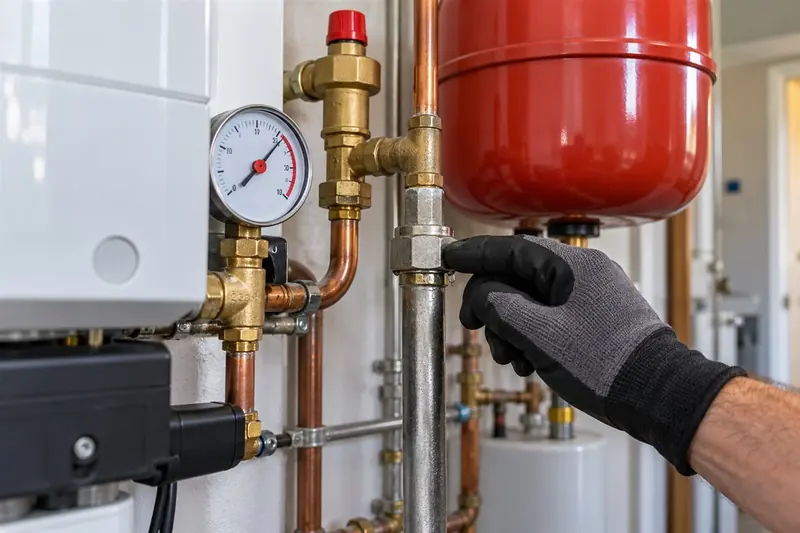
Most modern boilers run a sealed (pressurized) circuit: the same water circulates between the boiler and your radiators or baseboards, held at roughly 1 to 1.5 bar when cold. As water heats it expands, and the expansion vessel absorbs that extra volume so pressure stays within range. The pressure gauge on or near the boiler shows you the current state at a glance.
A healthy system holds its pressure for months. A system that needs topping up every few days or weeks is telling you something is wrong — the water is going somewhere it shouldn't.
Common causes of repeated pressure loss
Small leaks. The most common cause. Weeping radiator valves, loose compression joints, or pinholes in pipework can lose water slowly enough that you never see a puddle — it evaporates on a hot pipe first. Check valve connections and bleed points for staining or mineral deposits.
Relief-valve discharge. If pressure climbs too high, the pressure relief valve opens and dumps water outside through its discharge pipe. A valve that keeps lifting — or one that no longer reseats properly — will drain the system steadily. Look for a damp patch or staining where the discharge pipe terminates outside.
Expansion vessel faults. If the vessel loses its air charge or its diaphragm fails, there is nowhere for heated water to expand. Pressure spikes when the boiler fires, the relief valve lifts, and the system ends up low again once it cools. This on-off cycle is a classic signature.
Filling loop or fill-component issues. A filling loop left slightly open, or automatic fill components that misbehave, can mask or complicate the picture. The fill point itself should be checked during diagnosis.
What you can safely check
Note how often you top up and how far the gauge falls between fills — that pattern is genuinely useful to a provider. Look for visible damp, staining around radiator valves, and the outside end of the relief discharge pipe. Do not keep topping up indefinitely without investigation: fresh water brings oxygen that accelerates internal corrosion.
What a provider checks during diagnosis
A proper diagnosis separates the symptom from the cause: pressure behavior cold versus hot, expansion vessel charge, relief-valve condition, and a systematic search for weeps at valves and joints. For the full picture of what this visit covers, see boiler leak and pressure repair in Medford. If radiators also heat unevenly, maintenance and power flushing may be discussed once the pressure fault is resolved.
When it becomes urgent
Call promptly — via emergency boiler repair if you have no heat — when pressure drops to zero, the boiler locks out repeatedly, you find active water, or the relief pipe runs constantly. Those signs point to a fault that topping up will not outrun.
Questions to ask before approving work
Ask what the provider believes is losing the water, and how they ruled out the other causes. Ask whether the expansion vessel was tested rather than assumed. And ask what the first visit includes versus what would trigger a follow-up — pressure faults sometimes need a hot-and-cold observation cycle to pin down.
Related service pages
For diagnosis and repair, see boiler leak and pressure repair in Medford. For related symptoms, review boiler maintenance and power flushing, radiator and baseboard heating repair, and request service when you are ready to describe the issue.